
Article
The Autonomy Paradox
August 30, 2026 · Ronald Rubens
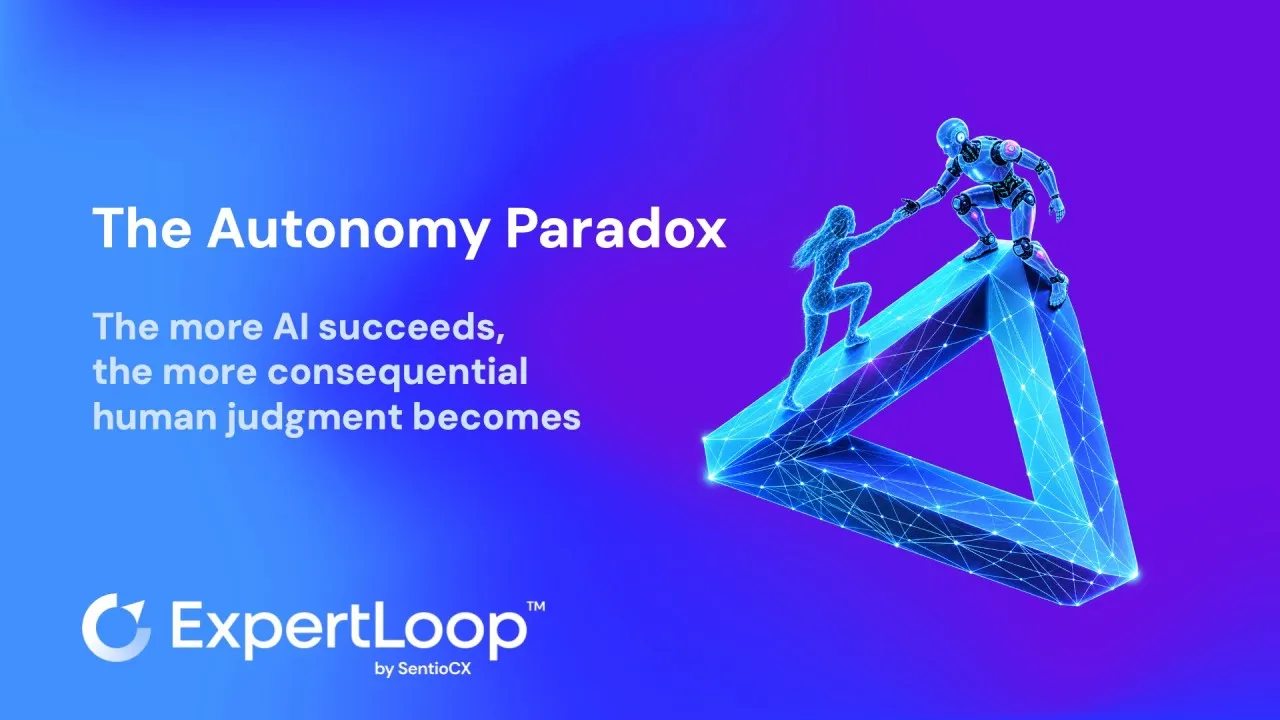
The more AI succeeds, the more consequential human judgment becomes.
Not a single day goes by without the same drumbeat. Autonomy is up. Resolution rates are climbing. AI Agents are being deployed, scaled, and monetized. Earnings calls, product launches and board decks emphasize their progress with AI: the share of work handled without a human, climbing steadily.
Mission accomplished, KPI’s met. It is impressive, it really is, and I understand the excitement. I share it. But here is the catch….
Behind that chart, on an ordinary Tuesday morning, something happens that autonomous-resolution statistics don’t capture. Here is my conclusion upfront: AI will not make human judgment less important. It will make access to that judgment more consequential. Humans will deal with fewer cases, but the cases that reach them will be harder, more urgent and less interchangeable. Let’s take a closer look.
11:47AM on a Tuesday morning at a Bank
Maria is a senior risk analyst at a digital bank. She holds authority level 5, the kind of mandate that takes years to develop. She is, by every measure the most experienced expert, with the highest proficiency in risk, fraud, compliance and complex claims.
At 11:47, four AI agents decide, independently and correctly, that they need a person like Maria.
The claims agent needs someone with Maria’s authority; a payments agent needs approval to release a high-value transfer. A fraud agent sees EUR 500,000 at risk. A corporate-servicing agent is dealing with a EUR 2 million account that has been frozen in error. A compliance agent has a regulatory deadline expiring in seven minutes. Four requests. Maria happens to be the very best match.
A traditional human-in-the-loop mechanism answers: find someone qualified to handle the cases. The harder question is: Which request gets Maria right now? And ten seconds later, when the fraud exposure doubles, should the answer change?
I believe that question will become increasingly important as enterprises deploy more autonomous systems. But there is an uncomfortable truth we first need to acknowledge.
A considerable portion of today’s AI-to-human routing problem is going to disappear.
Imagine a bank handles ten million interactions a year and three million currently involve humans. Today agentic AI is able to resolve between 60% - 80%. But let’s imagine - for argument sake that AI resolves 98 % autonomously. Suddenly only two hundred thousand interactions need human involvement.
If your business is moving linear workflows and interactions into queues, the math becomes a challenge.
AI doesn’t simply reduce human work. It concentrates it.
AI success changes the economics of human intervention. It absorbs routine execution and concentrates human attention on fewer, harder, more consequential decisions. The human experts become scarce.
AI changes the composition of human capital. The biggest impact of agentic AI is not automation. It is the transformation of that human capital.
AI absorbs execution. Humans concentrate on exactly the things that cannot be absorbed: judgment, authority, expertise, accountability. Which means human attention becomes the scarcest resource in the operating model, precisely because everything around it has been automated.
The evidence increasingly points in the same direction. Microsoft’s 2026 Work Trend Index describes the same equation: as agents take on execution, humans increasingly direct the work, make the calls, and own the outcomes. Microsoft also reports a 15x year-over-year increase in active agents in its ecosystem, rising to 18x in large enterprises. Even if each individual agent rarely needs a human, the denominator is exploding.
Anthropic’s Economic Index adds another interesting nuance: usage data does not show a simple march toward fully autonomous work. The index explicitly distinguishes automation from augmentation, and in its most recent samples, augmentative, collaborative interactions actually increased slightly. This pattern is more complex than “AI replaces the human.”
A research organization called METR makes another important point.
For reliability-critical or difficult-to-verify work, some tasks may require success probabilities above 98% before full automation makes sense. METR also warns that reducing the frequency of human intervention doesn’t necessarily reduce its cost: the failures that remain may be more complex and require more human effort.
In other words:
Fewer interventions; harder interventions; higher stakes per intervention.
Back to our paradox
Human intervention is not evidence that your AI is failing. Designed correctly, human intervention becomes more valuable as your AI succeeds.
The AI may know exactly what should happen. But it may still require human experts for: judgment, authority, accountability, empathy, exception or expertise.
Consider our earlier thesis of 98 % autonomous resolution. Look at what can live in the remaining 2%: mortgage approvals, AML exceptions, major insurance claims, vulnerable customers, fraud interventions, account closures, regulated complaints, high-value retention.
The volume has collapsed. The consequence per intervention has not. If anything, it has increased. And because almost everything surrounding those humans has been automated, each expert becomes extraordinarily leveraged. Which means the decision about which request deserves that person’s attention first, and which can wait, quietly becomes one of the most economically important decisions in the agentic enterprise. Made continuously; under changing conditions; with money, regulation, and customer trust on the line.
Perhaps we should stop calling it a handoff
I have used the word ‘handoff’ for years, but I am no longer sure it is the right word any longer :-)
In the old model, the AI handed over a conversation or case and the person took it from there. In an agentic enterprise, the AI may keep ownership of the work and ask a person to contribute for one decision.
The pattern looks like this:
The human may participate for thirty seconds. They approve. They judge. They clarify. They authorize. They override. Then the agent continues autonomously.
That is not a handoff. It is an intervention. Or, put more precisely: the AI is invoking a human capability.
Once you look at it that way, the unit of work changes. The thing that needs governing is no longer “a customer interaction requiring routing.” It is a request by an autonomous system for scarce human judgment, expertise, or authority.
That is a profound difference. And once many autonomous systems make those requests simultaneously, something has to arbitrate between them.
Why traditional routing reached its limits
Traditional routing already does more than it is sometimes given credit for. Modern omnichannel routing and workflow systems can match skills, apply service levels, recognize authority constraints and, in some cases, reprioritize work. They solve an important operational problem and will remain part of the answer.
The emerging challenge is different: traditional routing still operates within defined linear workflows, channels or set of queues. Their core question is: where should this work item or interaction go? Some can change its priority, but typically within the same workflow and according to rules defined in advance. The audit trail records who handled the work, but not necessarily why that person was the best use of scarce human authority relative to everything else competing for their attention. It served a world where human demand was broad, and roughly interchangeable.
The residual world is different: narrow, more complex and far less interchangeable. Fraud exposure, compliance deadlines, vulnerability indicators and revenue risk can change from one moment to the next in real-time, while several autonomous systems compete for the same few experts.
My estimate is that at least one in five interactions still needs human intervention today. But even as autonomy climbs toward 98 percent over the next five years, what remains is a disproportionate concentration of complexity and consequence that a queue simply cannot process. It does not necessarily arbitrate continuously across multiple autonomous systems, reconsider which request matters most and change the decision as circumstances evolve.
Human access decisioning asks: when autonomous systems require human judgment or authority, which human expert should intervene, with what priority, at what moment? And, can I make this explainable and auditable?
Won’t the AI platforms simply build this?
Of course AI platforms will build human-in-the-loop capabilities. They should. A confidence threshold is crossed, a guardrail is triggered, or an approval is required, and the workflow calls a qualified person. That is becoming table stakes.
But that solves the first-order problem. The difficult nut-to-crack begins when multiple autonomous systems compete for the same scarce group of experts. Then the question is no longer “can I reach a human?” It is: which of these forty-seven simultaneous requests gets which expert, in what order, based on intent, risk, impact, sentiment, authority level, proficiency, availability, and predicted wait time? And how does that answer update, continuously, as a deadline approaches or a fraud amount grows, while each customer and workflow stays inside the AI agent until the expert intervenes?
That is a genuinely different decisioning problem, and a new category emerging as we speak. It addresses a real-time infrastructural challenge for human attention, not simply another escalation rule.
Regulation strengthens the importance of getting this right, especially in regulatory industries. In the EU, for example, the AI Act requires effective human oversight for high-risk AI systems and requires deployers to assign that oversight to people with the necessary competence, training and authority. It also creates traceability and logging requirements for high-risk systems. In the US, model-risk management guidance and fair-lending rules push in the same direction: consequential automated decisions need competent human oversight and an explainable record of how they were reached.
This means the further regulated enterprises push autonomy into consequential work, the more important it becomes that human oversight is competent, deliberate and traceable.
Governing human access is therefore not necessarily the enemy of maximum autonomy. It is the enabler and safety-net for autonomy.
Autonomous resolution will not scale in regulated industries until the AI-human boundary is governed and provable.
There is one further implication worth spelling out, particularly for risk and compliance leaders. It is an important one for several reasons.
If every team embeds its own intervention logic inside its own agents, the enterprise gradually accumulates hundreds of separate human-in-the-loop policies. They are written differently, monitored separately and changed independently. Every new agent becomes another place where the rules can drift, conflict or simply be incorrect. Apart from the time-consuming tasks of adjusting workflows for human-in-the-loop, when a regulator asks whether human oversight has been applied consistently, the answer has to be reconstructed across multiple systems and workflows.
Human access decisioning should be a platform-wide capability, rather than something configured separately inside every single workflow.
Prioritization logic shouldn’t be rebuilt workflow-by-workflow. The common policies governing authority, priority, evidence and auditability can be defined and enforced consistently, while individual business domains retain the rules specific to their work. This not only drives governance, but also operational efficiency.
A platform-wide capability does not mean that every agent follows the same intervention policy. A fraud agent and a claims agent will have different requirements. It means those policies are governed through a decisioning framework, using consistent definitions, controls and audit standards. We have called this the ‘business impact prioritization framework’ which is an integral part of ExpertLoop™.
Where we stand
At SentioCX we have spent five years on this problem. I have to admit, we were early. The solution we have built is called ExpertLoop™: a human access decisioning layer that governs how autonomous systems obtain scarce human judgment, expertise, and authority when it matters.
ExpertLoop™ is a platform-wide capability that can run as a neutral decisioning engine alongside an organization’s existing AI, workflow, claims and routing technologies. It integrates through APIs and MCP, either directly into an enterprise technology stack or as an embedded capability within banking operating platforms and insurance core platforms. The existing systems retain the context, remain the systems of record and execute the decision.
For organizations operating on Salesforce, we’ve also developed a fully productized edition that extends Service Cloud, Omni-Channel and Agentforce; accessible via AgentExchange and AppExchange. The Salesforce edition is one productized deployment of ExpertLoop™; the underlying decisioning capability remains platform-independent.
The question I would leave with CPOs, CTOs, heads of compliance and risk committees within agentic enterprises:
When thousands of agents can each decide they need a human, what decides that Maria intervenes first, at what priority, what can wait, and how the answer changes as conditions change? And when the regulator asks, can you prove why?
I’d genuinely value perspectives from those building and operating agentic systems at scale. Thank you.
Ronald Rubens is Founder and CEO of SentioCX, the company behind ExpertLoop™, the patented human access decisioning layer governing AI-to-human escalations in enterprise agentic environments. This article was first published on LinkedIn.