
Article
The Handoff is where Agentic AI is Quietly Failing
May 14, 2026 · Ronald Rubens
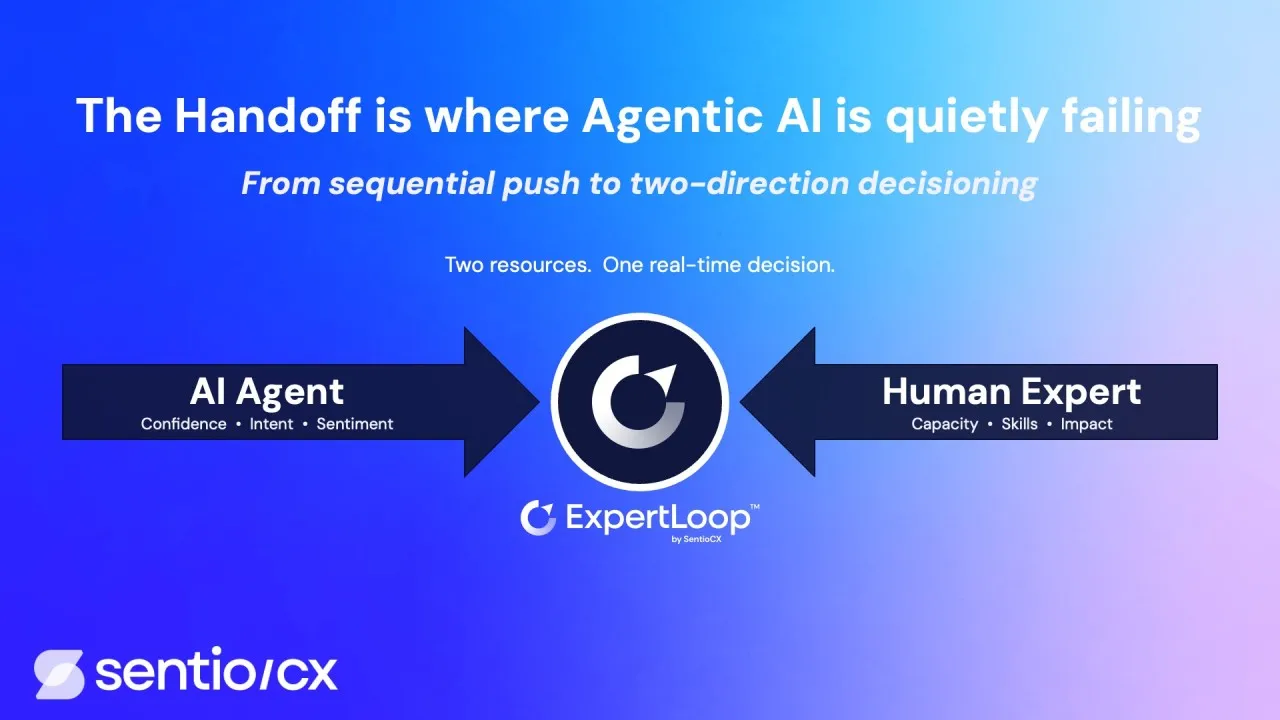
Why we need to stop treating the AI-to-human transition as sequential, and start approaching it from two directions
A few days ago, I attended a GLG webinar titled “Moving from Agentic AI Adoption to Impact.” One observation stayed with me: building trust in Agentic AI requires real time and active human oversight, typically one to two quarters of structured human-in-the-loop review, tracking actions, alignment, behavioral drift, and demonstrated positive impact, before an agent is genuinely trusted to operate at enterprise scale.
While this is a refreshingly honest framing of what technology is currently capable of, it crystallized a question I have been wrestling with for five years:
Are we aiming for 100% automation including trust, or are we asymptotically approaching an 80% ceiling, beyond which compliance, risk, ambiguity, emotion, and human judgment will always require a human?
The 2026 data points to the latter. Salesforce’s 7th State of Service report (surveying 6,500 service professionals globally) projects that AI will resolve 50% of service cases by 2027, up from 30% in 2025. Even the most aggressive Agentic AI vendor in the market is, in its own data, projecting that half of all service interactions will still require humans two years from now. The remaining 50% (the long tail of complex, regulated, emotionally charged, or business-critical cases) is where customer trust, revenue retention, and brand equity are actually decided.
The Handoff Is the Hidden Tax on Every AI Deployment
This is exactly where current architectures fail. Only 15% of consumers experience a seamless handoff from AI to a human (SurveyMonkey 2026). 29% stop buying altogether because of poor customer experience.
In B2B the economics can be brutal. Consider deflecting 1,000 interactions for roughly $10K in operational savings. If just 2% of those customers churn at a $5K annual contract value, you have lost $100K chasing $10K in savings. The industry is celebrating deflection rates while quietly bleeding from the handoff.
Why the Linear Model Is Broken
The root cause is architectural. Most Agentic AI deployments today treat the handoff as a linear, sequential event; the AI tries, fails, pushes the conversation into a queue or worse a customer is begging to be connected to a human; A human picks it up. This worked for deterministic chatbots; it does not work for Agentic AI.
Agentic AI is fundamentally probabilistic; it operates under uncertainty, with shifting confidence, drifting performance, and an internal state that varies by query, context, and underlying model version.
You cannot bolt a deterministic, push-based escalation workflow onto a probabilistic execution engine and expect the seams to hold
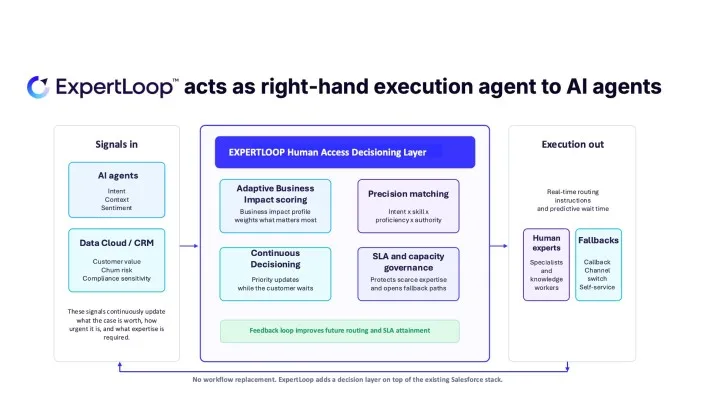
This is why Human Access Infrastructure (HAI) is emerging as a distinct architectural layer, sitting between Agentic AI execution and the workforce that backs it. HAI is not a routing tool. It is not a queue. It is the real-time decisioning layer that governs exactly when, how, and who to involve, based on intent(s), signals, sentiment, the joint state of the AI’s confidence and the expert pool’s availability, skill, proficiency-level(s) and business impact profile. It treats human attention for what it actually is: a scarce, congestible, strategically valuable resource.
The Math Now Confirms What Operators Intuit
A February 2026 paper from Texas Tech University “Operating Imperfect AI: Reliability Drift and Human Congestion” (Wang and Rachev), provides independent academic confirmation. Modeling the AI-human system as a dynamic queuing control problem, the authors prove three things every CX and Field Service leader should internalize:
- optimal escalation policies are driven by a Shadow Price of Capacity, the real-time cost of consuming a scarce human;
- systems must perform Congestion Shedding (raise thresholds when humans are overloaded) and Safety Buffering (lower thresholds when the AI begins to drift) simultaneously;
- there is a hard Capacity Phase Transition in the parameter space beyond which no algorithm can save the system, regardless of how good the AI becomes.
The mathematics, in short, confirms the operational reality: you cannot solve this by improving the model alone. The interface between AI and humans is its own optimization problem.
Link to Texas Tech University article
The Bidirectional Imperative: From Sequential Handoff to Joint Routing
The fix is to stop thinking about the handoff as a one-way street.
A bilateral architecture optimizes from both sides simultaneously: the demand side (what the customer or task actually needs in this moment) and the supply side (which expert is available, with what skill, at what cost, against what SLA).
Demand side: precision matching
The first unlock is precision matching, not “route on topic,” not “escalate on sentiment threshold.” Precision matching means inferring intent from the unfolding interaction, weighting it against contextual signals (urgency, customer value, regulatory exposure, conversation history, business impact) and using that composite to decide whether human involvement is needed, and which human is the right one.
Four years ago, when we filed our patent on Predictive Intent-Based Routing (US 11658886), ChatGPT did not yet exist. By the time the patent was granted in May 2023, ChatGPT had just launched, and the world suddenly understood why intent(s) would matter. But we already believed something had changed: the unit of decision in any AI-human system is intent, not topic. Topic tells you what a conversation is about. Intent tells you what the customer is actually trying to accomplish, how confident the system should be in helping them, and whether a human needs to be involved.
Today, we have substantially extended that foundation. ExpertLoop™ today combines intent inference with a wider signal set: customer churn risk, lifetime value, regulatory exposure, sentiment trajectory, SLA proximity, and the AI’s own confidence state. Those signals feed adaptive triaging; the live decision of which level of human expert is the right match for this specific interaction, right now, given both the demand signal and the real-time supply of expert capacity. What started as intent-based routing has become real-time, bilateral, impact-weighted decisioning. The patent was the foundation. The signal layer and the supply-side intelligence are what we have built on top.
Demand side: the AI’s own uncertainty
The second demand-side signal is the AI’s own confidence. Modern frontier models (e.g. Anthropic’s Claude in particular) are explicitly calibrated to express uncertainty rather than fabricate. Claude Opus 4.7 currently posts the lowest hallucination rate of any frontier model on the AA-Omniscience benchmark, approximately 50 percentage points better than GPT-5.5, and Anthropic attributes this directly to a deliberate refusal strategy: train the model to say “I don’t know” rather than guess.
This is operationally significant. It means the AI itself emits pre-hallucination signals; degraded confidence, retrieval gaps, semantic inconsistency, verbosity compensation that a properly instrumented Human-Access-Infrastructure layer can detect before the model commits an error to the customer. A proactive handoff triggered by the AI’s own internal state is structurally different from a reactive handoff triggered by a customer escalating in frustration. The first protects trust. The second tries to recover it. Most enterprises today only do the second.
Supply side: the real challenge is expert scarcity
Precision matching is necessary. It is not sufficient. The harder, less-discussed half of the problem is expert scarcity.
Every CX and Field Service organization is staring at the same reality. Experienced field engineers, senior service agents, specialists, supervisors are the most expensive, most constrained, and most strategically valuable human resources in the enterprise. They cannot be scaled by hiring. They will not be replaced by AI on any honest 5-year horizon. And today they are routinely overloaded by escalations that are mistimed, under-contextualized, or simply unnecessary.
The bidirectional approach has two complementary moves:
- Adaptive triaging. Rather than defaulting every escalation to the highest-skilled available expert, the system continuously re-evaluates which level of human is the right match; given the AI’s current confidence, the customer’s signals, the business impact, and the real-time skills inventory on the supply side. The same query that requires a senior specialist when the AI is uncertain may only require a Tier-1 reviewer when the AI is confident and the customer is calm. The match is dynamic, not static.
- Protecting your scarcest experts. When the demand for human escalations increases or the AI begins to drift, the system must not blindly continue pushing escalations into a saturated expert pool. It must make active business decisions about which escalations to absorb, which to handle with a confident automated response and a follow-up, and which to defer or reroute — always with customer business impact in view. Wang and Rachev’s “Congestion Shedding” and “Safety Buffering,” translated into operational language, is exactly this: protect the experts most likely to retain the customer, not simply escalating to a human expert with a ‘skill-tag’. It is the difference between optimizing the queue and optimizing the business.
From ‘Cost-per-Contact’ to ‘Return on Expert Minute’
CX and Field Service platforms have spent two decades optimizing cost per contact. It was the right metric when human labor was the only labor.
In the agentic enterprise it is no longer the right metric. AI now handles 40–60% of contacts at roughly $0.62 per resolution versus $7.40 for a human (McKinsey AI in Customer Service 2026). The human minutes that remain are the ones with the highest stakes, where customer lifetime value, regulatory exposure, field service outcomes, and brand trust are on the line.
The right question is no longer “how cheaply can we close this interaction?” It is: “how do we maximize the return on every minute of scarce expert attention?”
Why We Built ExpertLoop™
Five years ago we made a deliberate bet: the bottleneck of the agentic enterprise would not be the AI itself, but the interface between AI and the humans who back it. That bet is now being independently validated by frontier model providers, academic researchers, and the operational data emerging from every large-scale agentic deployment.
ExpertLoop™ is the patented Human Access Infrastructure built specifically for this layer. It acts a “right-hand-execution-agent” to AI-agents to govern human access bilaterally, combining Predictive Intent-Based Routing on the demand side with real-time expert availability, skill, and impact-weighted decisioning on the supply side. It captures AI confidence signals from models like Claude, GPT, and Gemini to trigger proactive handoffs before trust is damaged. It operationalizes Adaptive Triaging and impact-based throttling as live business policy, not as technical configuration. And it does all of this while operationalizing the AI safety and human oversight requirements.
The handoff problem will not be solved by a better model. It will not be solved by a smarter AI agent. It will be solved by the layer that decides, in real time and bilaterally, how scarce human judgment is allocated against probabilistic AI execution.
In the Agentic Enterprise, the platform that governs human access governs enterprise trust.