
Article
Lessons from AI Constitution and Salesforce CEO Marc Benioff at Davos
January 25, 2026 · SentioCX
Just days ago, two developments emerged from very different corners of the AI ecosystem. Taken together, they form a signal that every executive should take seriously.
First, Anthropic published its AI Constitution, a detailed framework defining how advanced AI models should prioritize safety, ethics, honesty, and human oversight. Its core message is unambiguous: “as AI systems become more capable, being safely governable must take precedence over being maximally useful.”
Second, at the World Economic Forum in Davos, Salesforce Chair and CEO Marc Benioff delivered a clear cautionary message. AI systems operating without strong governance have already caused real-world harm, particularly to younger generations. Regulation and accountability, he emphasized, are not distant or hypothetical concerns; they are fast becoming unavoidable.
Together, these two moments point to the same conclusion: safety and human oversight must be embedded into day-to-day AI deployment!
In short, AI safety is no longer a technical debate: It is a leadership responsibility. Let’s further unpeel the onion of these two events in the 3rd week of January 2026.
Anthropic’s AI Constitution
Anthropic’s AI Constitution makes a striking assertion that deserves attention well beyond the research community: the most critical property of advanced AI today is not intelligence alone, but its willingness to defer to appropriate human oversight.
The document prioritizes being “broadly safe” above helpfulness or efficiency. Safety, in this context, is defined as not undermining human mechanisms that supervise, correct, or halt AI behavior — even when the model is confident in its own reasoning.
Crucially, the Constitution acknowledges that ethical judgment inside a model will inevitably be imperfect. Real-world deployment introduces ambiguity, conflicting priorities, and material risk that static rules cannot fully anticipate.
As AI systems become more agentic and increasingly embedded in enterprise workflows and interactions, the Constitution implicitly points to a requirement that sits outside the model itself: a structured, contextual decision capability that can continuously assess intent, confidence, and impact — and determine when autonomy should give way to human authority.
This is not framed as a failure of AI. It is presented as a prerequisite for trust, accountability, and safe scale.
Salesforce CEO Marc Benioff at Davos: A Reality Check
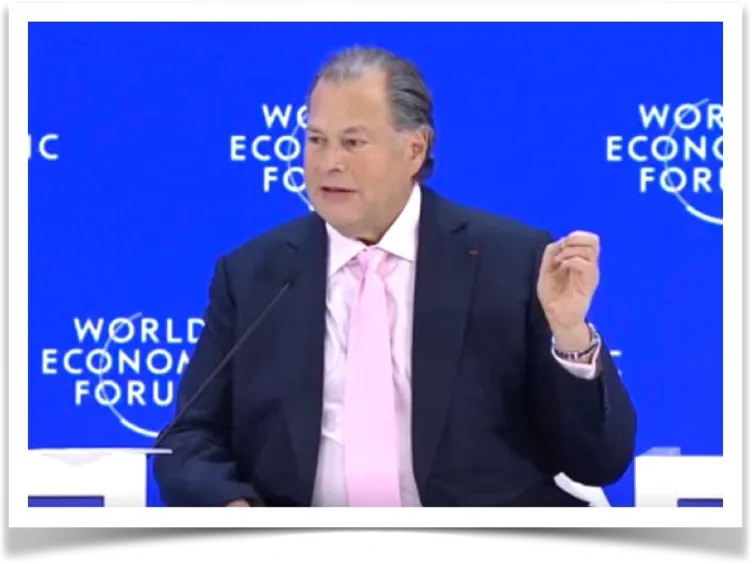
Marc Benioff’s Davos remarks focused on a stark enterprise and societal reality check.
In Salesforce’s own summary of the session, Benioff warned that “large language models (LLMs) can simulate human conversations without the contextual grounding required for responsible interaction.” Hallucinations, Benioff noted, are not merely technical imperfections; they pose real risks, particularly for younger or vulnerable users.
The implication is clear. The speed and complexity of LLM adoption are outpacing existing governance structures. Relying on goodwill, post-hoc fixes, or internal assurances is no longer sufficient.
The path to sustainable technological growth now depends on balancing innovation with an unwavering commitment to social responsibility.
Why this matters for Agentic Enterprises
The above two events highlight a core tension in advanced AI deployment:
As models become more capable; making them safe and human-centric isn’t just about rules, it’s about embedding values that preserve human oversight, clarity, and trust.
Yet the prevailing architecture of AI agents still assumes that the agent itself will internalize and reason over those values. That assumption introduces systemic operational risk:
- What if the AI misinterprets priorities?
- What if “helpfulness” competes with safety?
- How does an enterprise manage real-time risk when AI automates decision flows?
The bottom-line is to mitigate this risk by ranking safety above all else and instructing models not to undermine oversight. But it does not fundamentally eliminate the risk of autonomous action without organizational context.
In other words: Agentic enterprises must ensure human expert access when it matters most.
Why AI model-level safety is necessary, but currently insufficient
The framework outlined in Anthropic’s AI Constitution is an important step forward. It helps models reason more carefully about ethics and avoid harmful behavior. But from an enterprise perspective, it leaves a critical gap unresolved:
- Models do not understand business risk tolerance
- Models do not know when customer impact becomes material
- Models do not own regulatory accountability
- Models do not decide who is responsible when something goes wrong
Boards are ultimately accountable for outcomes: not intentions embedded in training data.
The missing layer: Decision authority between AI and Human Experts
As AI agents take on more customer-facing and operational work (particularly across CCaaS, CRM, and service workflows) the primary risk is not intentional misuse.
The risk is autonomous decision-making (or worse hallucination) continuing beyond the point where human judgment is required.
What enterprises need is not “more guardrails,” but a decision layer that continuously evaluates context, risk, and impact to determine:
- Is this interaction still safe to automate?
- Has the intent, sentiment, or impact crossed a threshold?
- Is this the moment to involve a human and if so, which one?
This is where SentioCX becomes essential.
The Essence of SentioCX ExpertLoop™
ExpertLoop™ operationalizes decision authority between AI agents and human experts, ensuring access to the right expertise at the right moment, when it matters most.
It provides:
- Intent-level human oversight: enabling real-world intervention when uncertainty, ambiguity, or risk rises
- Contextual decision layering: ensuring ethical and responsible behavior across workflows and interactions, not just within AI models
- Structured transitions between Agentic AI and human experts: activating the right expert at the right moment through intelligent pairing and adaptive/continuous triaging
- Risk mitigation beyond internal AI values: protecting governance, compliance, and brand trust even in edge cases
This is where traditional routing logic falls short.
“First available agent” models or simply putting a rule-based priority mechanism in place to jump the queue are no longer sufficient.
Meaningful expert access requires fine-grained pairing of intent and real-time signals with the appropriate skills, authority, and proficiency of human experts.
What’s needed is a real-time decision layer that continuously triages work by business impact and risk and intelligently activates the right expert at the right moment across channels, agents, and workflows.
ExpertLoop™ ensures accountability is real and outcomes matter, acting as an adaptive triage and decision layer for human expert access.
This is exactly what SentioCX ExpertLoop™ was built to do.
Turning AI Safety and Human oversight into Reality
As AI agents become more agentic and embedded within enterprises, the question facing leaders is no longer whether AI can act responsibly, but whether organizations have built the structures required to ensure AI safety and Human oversight.
If you’re curious how this decision layer can be implemented in practice, and how it works within the Salesforce ecosystem, watch the video in the link below or contact me at ronald@sentiocx.com